Figuring out hydraulic cylinder displacement helps when you design or maintain these systems. The number shows how much fluid moves the piston. Power, speed, and efficiency all depend on it. Accurate numbers keep the cylinder working right even when loads change.
What is Hydraulic Cylinder Displacement?
Hydraulic cylinder displacement measures the fluid volume that shifts as the piston moves a set distance inside the cylinder. You figure this value from the piston’s travel over its full stroke. The number shows how much fluid the system must supply to push the piston out or draw it back. In real setups this figure shapes actuator behavior and overall system response.
Displacement shows how much work your hydraulic fluid handles in one cycle. A bigger displacement moves more fluid each time. This gives you stronger force or longer strokes. Smaller displacement works better when you need tighter control or quicker cycles.
Formula for Calculating Hydraulic Cylinder Displacement
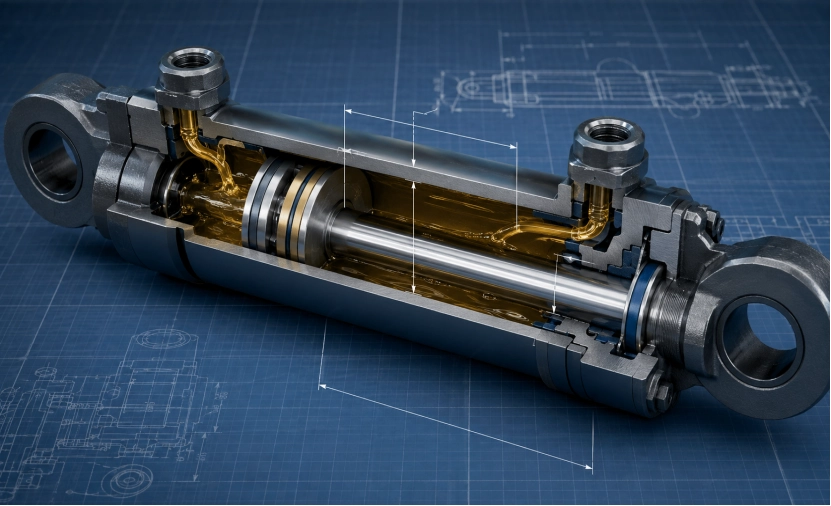
Getting the numbers right starts with knowing the key sizes at play.
- Bore Diameter (D): This measures the inside width of the cylinder itself.
- Rod Diameter (d): It shows how thick the piston rod is.
- Stroke Length (L): You see here the full travel distance of the piston in the cylinder.
From these you build the basic formula for hydraulic cylinder displacement.
Displacement (V) = Area × Stroke
For a single-acting cylinder: V = (π × D² / 4) × L
For a double-acting cylinder, both extension and retraction sides must be considered:
| Operation | Formula |
| Extension | V₁ = (π × D² / 4) × L |
| Retraction | V₂ = [π × (D² − d²) / 4] × L |
These formulas help engineers calculate how much oil is needed to move the piston through its full stroke.
Step-by-Step Calculation Process
Let’s walk through an example using these equations.
- Determine Dimensions: Suppose a hydraulic cylinder has a bore diameter of 100 mm, a rod diameter of 40 mm, and a stroke length of 500 mm.
- Calculate Piston Area: A = π × D² / 4 = 7854 mm²
- Calculate Rod Area: A_r = π × d² / 4 = 1256 mm²
- Extension Volume: V₁ = A × L = 3,927,000 mm³
- Retraction Volume: V₂ = (A − A_r) × L = 3,299,000 mm³
Converting to liters: 1 liter = 1,000,000 mm³. So extension volume ≈ 3.93 L, retraction volume ≈ 3.30 L.
This difference matters because it affects return speeds and flow balancing in double-acting systems.
Role of Displacement Calculation in Practical Hydraulic Systems
Accurate displacement calculation ensures that every component—from pumps to valves—works harmoniously within design limits.
Optimized Flow & Speed
Displacement knowledge lets you set the right pump flow rates and predict actuator speeds. Match flow rate to displacement the wrong way and motion slows down or races ahead. Seals and joints then face extra stress from that mismatch.
Reservoir Sizing & System Safety
Reservoirs need to store enough fluid. This covers every volume shift that occurs once the system starts running. Underestimating displacement often leads to cavitation. Oil fails to reach the pump inlet in sufficient volume, and the result shows up quickly in compact setups. The problem appears regularly, yet it stays easy to prevent with proper sizing.
Synchronization & Control
Multiple cylinders in one system rarely share identical displacement. The difference produces uneven actuator motion. Engineers calculate the exact values needed to bring the motion into line. This step matters most for lifting platforms and steering mechanisms, since timing controls the outcome.
Common Mistakes and Tips
Common errors include:
- Ignoring rod volume when calculating retraction side.
- Forgetting unit conversions between cubic millimeters and liters.
- Overlooking temperature effects on fluid expansion.
Tips:
- Always verify bore and rod diameters from manufacturer datasheets.
- Use consistent units across all calculations.
- Simulate results using CAD or hydraulic software before final assembly.
Selecting the Right System
Pick parts using exact displacement numbers. This step keeps pump output in line with what the actuator actually needs.High-displacement cylinders work best with slower pumps on heavy loads.Low-displacement cylinders suit fast automation lines that must finish cycles quickly.
Swept Volume vs. Total Cylinder Volume
These two terms often confuse beginners but represent different aspects of hydraulic performance.
Swept Volume
Swept volume points to the usable space the piston displaces during its stroke. This lines up with the area multiplied by stroke length we calculated earlier. It shows how much fluid takes part in creating motion each cycle.
Total Cylinder Volume
Total volume covers swept volume plus any dead space left when the piston pulls all the way back. Clearances behind seals or ports count as typical examples. Engineers rely on this figure to size reservoirs so they can manage peak system demand. The result keeps fluid from spilling over or leaving the circuit short during actual use.
Conclusion
Calculating hydraulic cylinder displacement matters in practice. It shapes how reliable and efficient a system actually runs once it leaves the drawing board. Pump selection, valve sizing, reservoir capacity, and control response times all depend on this value being accurate. If you are troubleshooting an existing machine or starting from scratch, knowing how displacement affects system behavior gives you a real edge in the work. Need expert advice or cylinders made to your specs? Contact our team today to get the right fit for your application.
FAQs
Q1: How do I calculate hydraulic cylinder oil volume?
Use ( V = πD²L/4 ) for extension side; subtract rod area for retraction side if it’s double acting.
Q2: Why does retraction volume differ from extension?
Because part of the bore area is occupied by the piston rod during retraction, reducing effective fluid space.
Q3: What units should I use for hydraulic calculations?
Always keep consistent units—typically millimeters for dimensions and liters for volumes—to avoid conversion errors.
Q4: Does temperature affect hydraulic displacement?
Not directly; however, thermal expansion changes oil density slightly, influencing total system pressure balance.
Q5: Can two cylinders with different displacements operate together?
Yes—but they’ll move at different speeds unless synchronized through flow dividers or proportional control valves.