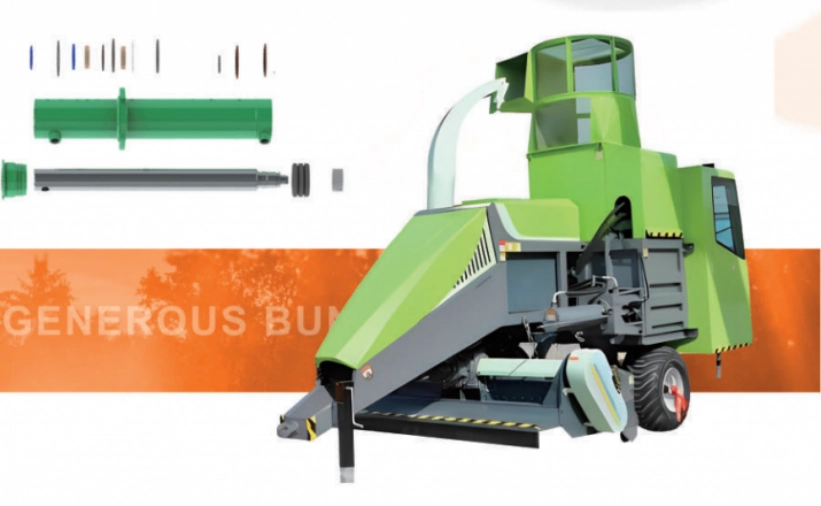
A film wrapping baler depends on several hydraulic cylinders doing different jobs. The main cylinder creates the pressing force. The pressing cylinder controls the material and helps form a consistent bale. The pushing cylinder clears the chamber.
Their timing matters as much as their size. A correctly selected cylinder can still cause jams, uneven density, or damaged mounts if it moves at the wrong point in the cycle.
What Happens Inside a Film Wrapping Baler?
Loose straw, forage, or silage enters the feeding area and moves into the compression chamber. The material is bulky and springy, so it must be restrained before useful pressure can be applied.
The baler closes around the material, compresses it, holds the load briefly, and transfers the finished bale toward the wrapping section. The wrapping unit is separate. The cylinders discussed here mainly handle positioning, compression, pressure holding, and discharge.
Most operating problems appear during these transitions. A bale may be dense enough, yet still jam because the chamber did not clear in time.
How Does Hydraulic Power Move the Baler Cylinders?
A hydraulic pump sends oil through directional control valves. Pressurized oil enters one side of a cylinder, pushes against the piston, and moves the rod. Oil from the opposite side returns to the tank.
Pressure determines available force. Flow determines movement speed. A larger piston can create more force at the same pressure, but it also needs more oil to travel at the same speed.
The main cylinder needs controlled force, not a violent stroke. The pushing cylinder needs enough speed to keep the cycle moving without throwing the bale into the next station.
What Does the Main Cylinder Do?
The main cylinder performs the primary compression stroke. It drives the main ram or pressing plate into the loose material and creates most of the final bale density.
This is normally the highest load cylinder in the system. Wet silage can require sustained force. Dry straw compresses, then tries to spring back as soon as pressure drops.
The cylinder needs adequate bore area, a rod that will not buckle during a long push, and mounts that remain aligned under load. Pressure holding matters too. If the main cylinder drifts backward before the bale is secured, bale weight and density begin to vary even though the machine still appears to operate normally.
What Does the Pressing Cylinder Do?
The pressing cylinder supports the main compression process. Depending on the design, it may press from the top, side, or another direction to hold material inside a defined chamber.
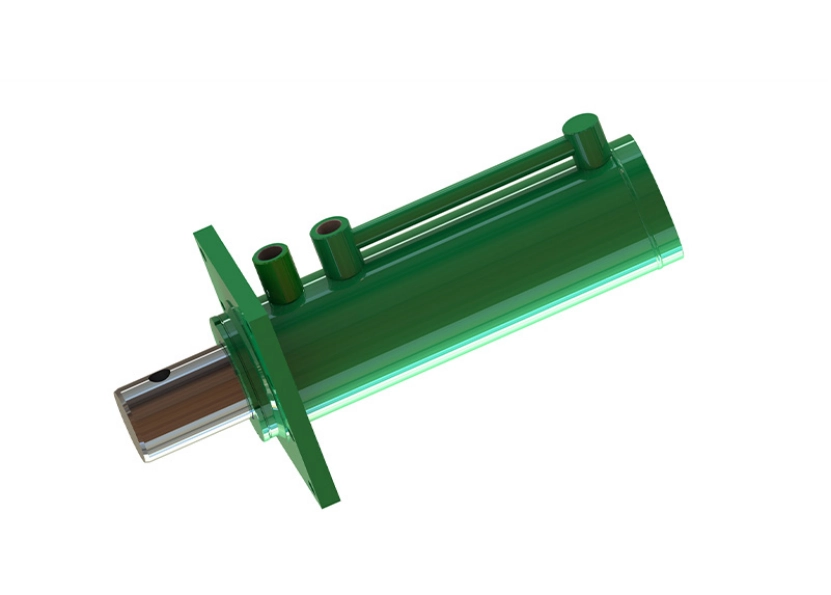
Its purpose is usually control rather than maximum force. It can reduce empty spaces, limit material movement, and improve the bale’s shape. On some machines it closes before the main cylinder moves. On others it applies a secondary press after the main stroke.
Loose edges, rounded corners, or material trapped near the chamber opening often point to trouble here. These symptoms are sometimes blamed on the crop, although pressure loss or incorrect valve timing may be the real cause.
What Does the Pushing Cylinder Do?
The pushing cylinder transfers the completed bale out of the compression chamber and toward the tying, transfer, or wrapping area.
It does not normally create bale density, but its load should not be underestimated. It must overcome chamber friction, bale springback, and resistance at the outlet. A dense, damp bale can drag harder than expected.
Stroke length is critical. The rod must move far enough to clear the chamber without bottoming out under load. It must also retract fully before new material enters. A short hesitation can disturb the entire cycle: the next charge arrives, the chamber remains partly occupied, and a delay becomes a jam.
How Do the Main, Pressing and Pushing Cylinders Work Together?
The cylinders operate as a sequence, not as independent actuators. A typical cycle is:
- Material loading: Loose material enters the chamber.
- Initial positioning: One cylinder moves or holds the material in the correct position.
- Primary compression: The main cylinder applies the main compressive force.
- Secondary pressing: The pressing cylinder improves density and bale shape.
- Pressure holding: One or more cylinders temporarily maintain pressure to reduce springback.
- Bale discharge: The pushing cylinder transfers the finished bale toward the wrapping area.
- Cylinder retraction: The cylinders return in sequence for the next cycle.
Sensors, pressure switches, limit switches, or a PLC may confirm each position. This interlocking protects the machine. If the pushing cylinder moves while the main ram is still extended, the bale can twist and apply side load to the chamber.
Good synchronization is almost unnoticeable: steady sound, brief pauses, square bales.
What Cylinder Features Improve Baler Reliability?
Film wrapping balers operate around dust, plant fibers, moisture, and repeated load changes. Useful cylinder features include:
- Strong sealing: Reduces internal bypass and external oil leakage.
- Wear resistant piston rod: Helps withstand dust, moisture and repeated cycles.
- Stable cushioning: Reduces impact near the end of the stroke.
- Secure mounting: Prevents misalignment and excessive side loading.
- Suitable bore and stroke: Provides the required force and movement range.
These features cannot correct poor sizing. Bore, rod diameter, stroke, closed length, mounting points, port size, and working pressure still need to match the machine. A heavier cylinder with the wrong geometry is not an improvement.
What Should You Check When a Baler Cylinder Stops Working Correctly?
Begin with visible conditions while the machine is safely unloaded. Check for oil around the rod seal, ports, hose fittings, and cylinder head. Look for scoring, corrosion, bending, or a polished wear mark on one side of the rod. One sided wear often indicates misalignment.
Movement gives more clues. Slow travel may come from low pump flow, a restricted valve, or internal leakage. Jerky motion can indicate air, contamination, or an unstable load. A cylinder that will not hold position may have worn piston seals, but a leaking control valve can produce the same symptom.
Replacing the cylinder before checking system pressure and valve function is usually an expensive guess.
Why Is Understanding Each Cylinder’s Function Important?
The main cylinder compresses the material. The pressing cylinder controls shape and density. The pushing cylinder clears the chamber.
Knowing which cylinder should carry the load at a specific moment makes fault diagnosis faster. It also prevents incorrect replacement decisions. Matching only the pin centers is not enough. Bore, stroke, retracted length, mounting style, port position, operating pressure, and duty cycle all matter.
A replacement hydraulic cylinder for a film wrapping baler should fit the machine’s working sequence, not merely its installation space.
At Shining Hydraulic, we understand that every cylinder in a baler has a specific role — from generating compression force to controlling bale shape and ensuring smooth discharge. We manufacture custom hydraulic cylinders designed for demanding agricultural applications, with the right bore, stroke, mounting configuration, and durability to match your machine’s working cycle.
Contact Shining Hydraulic today to discuss your hydraulic cylinder requirements and get a professional solution for your baler equipment.
FAQ
Q: Can one hydraulic cylinder perform all three functions?
A simple baler may combine functions, but separate cylinders usually provide better control of compression, bale shape, and discharge. The machine also becomes easier to sequence.
Q: Why does the main cylinder slow down near full extension?
The material becomes denser, so resistance rises. Pump capacity, valve restrictions, pressure settings, or intentional cushioning may also reduce speed near the end of the stroke.
Q: What causes a pressing cylinder to lose position?
Likely causes include internal seal leakage, external leakage, a control valve that does not seal properly, or insufficient system pressure.
Q: What information is needed for a replacement cylinder?
Confirm bore, rod diameter, stroke, retracted and extended length, mounting type, pin size, port details, working pressure, and the cylinder’s role in the operating cycle.