A larger cylinder can give a waste compactor more push and still leave the crew waiting longer between loads. That’s the awkward part of sizing waste compactor hydraulic cylinders: extra force takes extra oil, and the pump has only so much to give.
Picture a rear-loading truck collecting a hopper full of loose packaging. The packing mechanism moves through it easily, then meets material already squeezed into the body. The load changes. This is where the cylinder earns its size. The difficulty is getting enough push here without making the easier movements painfully slow.
Why Does the Compactor Load Change During a Stroke?
Loose cardboard gives way quite differently from a compressed bundle. A rigid object can also raise resistance well before the end of travel. There isn’t one neat load that covers the whole stroke.
For the designer, the useful question is where the machine needs its hardest push. A packing plate may need speed while crossing a lightly loaded part of its path. It needs force once the waste resists further movement.
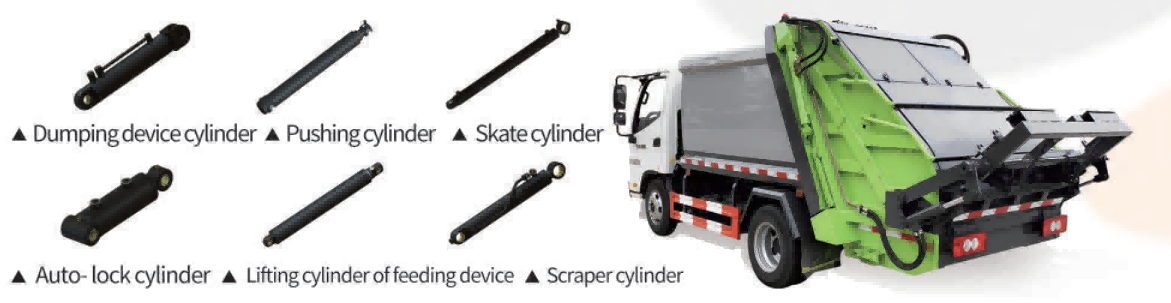
A truck also needs to lift incoming loads and secure moving parts. Those jobs belong to other waste compactor hydraulic cylinders. Giving the small locking cylinder the same bore as the packer would be an odd starting point. Sharing a hydraulic supply doesn’t make their jobs alike.
What Does a Larger Compactor Cylinder Bore Actually Change?
Put two possible bores on the drawing: 100 mm and 125 mm. For this example, both push directly through 800 mm of travel. There’s 180 bar at the cylinder inlet, with 40 litres of oil arriving each minute.
More Push from the Same Pressure
An extra 25 mm doesn’t sound dramatic. Across the whole circular piston face, it adds about 56% more area. Diameter is squared in the area calculation, which is why the increase is so large.
That takes the calculated cylinder force from about 141 kN to 221 kN: pressure multiplied by piston area. Here we’re counting push at the rod, with friction left out and almost no opposing return pressure. A linkage would change what reaches the packing plate.
That’s a substantial gain. If the smaller cylinder cannot finish the packing stroke, the extra area may be useful.
More Oil for Every Stroke
Now fill those two barrels. The 100 mm bore takes 6.28 litres over the specified stroke; the 125 mm one needs 9.82 litres. At 40 litres per minute, the pump cannot fill them in the same time.
| At the Same Pressure and Flow | 100 mm Bore | 125 mm Bore |
|---|---|---|
| Theoretical extension force | 141 kN | 221 kN |
| Oil for 800 mm extension | 6.28 L | 9.82 L |
| Ideal extension time | 9.4 seconds | 14.7 seconds |
The extra push costs about 5.3 seconds on extension alone. Retraction still has to happen.
If the original cylinder already packs the intended waste properly, that larger bore buys force the machine may rarely use. Meanwhile, every full extension takes longer. We would want a clear reason for that trade.
Where Can a Compactor Recover Cycle Time?
The packer has finished pushing, but the hopper isn’t ready yet. How long does the return take? And how much of the next stroke happens before the load gets heavy?
The Return Stroke Counts Too
During retraction, oil enters the rod side. The rod occupies some of the space, so this side needs less oil volume per millimetre of travel. At equal incoming flow, retraction is faster than extension.
It also has less pulling force at the same pressure. A quick empty return tells you little about whether the mechanism can pull back against trapped material.
There is another catch: oil leaving the full piston side must escape fast enough. A restricted return path can spoil the expected speed. Cylinder dimensions and the valve circuit need to agree on what happens during that return.
Fast Approach Has a Force Trade-Off
Oil coming out of the rod side doesn’t always have to go straight back to the tank. A regenerative circuit routes it into the inlet side instead. That extra oil helps fill the barrel faster during a lightly loaded extension.
There is a price: the rod side is pressurised too, opposing part of the push. Once the waste demands more force, the circuit needs to leave regeneration and allow a full-force stroke.
We’d look at how much light travel is actually available before choosing this arrangement. If resistance is high almost from the start, there isn’t much time to win back. And if the crew is waiting for incoming waste, speeding up the rod won’t remove that wait.
Why Can Equal Cylinder Force Produce Different Compaction?
The waste feels the packing face, not the cylinder bore.
Suppose a plate receives a direct pushing force of 150 kN. Spread across 0.5 square metres, that gives an average pressure of 300 kPa. Double the plate area to 1 square metre and the average drops to 150 kPa. Same force. Half the pressure over the face.
Actual waste doesn’t load a plate evenly, but the comparison explains why a force figure alone says little about the finished result. On a pivoting packer, the linkage changes the force reaching the waste as the mechanism moves.
Then there’s the load itself. Squeezed cardboard may expand again when the plate retreats. A rigid item may take the push while softer material beside it barely compresses. During a trial, look into the hopper after the plate comes back. Did the stroke leave room for another load, or does the same waste need another pass?
Build the Compactor Around Its Working Cycle
Decide how much push the difficult part needs, then look at where the seconds go. That gives the bore a job to meet.
If the choice between two bores still looks close, talk through the packing cycle with us. A sketch of the movement and an example of the intended waste give us something concrete to work with.
FAQ
Does Higher Pressure Make a Compactor Cylinder Faster?
At a fixed delivered flow, higher pressure mainly provides more force. It can restore movement if the load was stopping the cylinder, but it doesn’t automatically increase the speed of a freely moving rod.
Can Every Compactor Cylinder Use the Same Bore?
They can share a bore where their loads and travel requirements justify it. Standardising everything around the packing cylinder, though, can leave smaller handling functions unnecessarily bulky and slow.
Is the Shortest Compactor Cycle Always the Best?
Only if it completes useful packing. A fast stroke that leaves the hopper needing another pass may lose its advantage. Compare completed work with representative waste, including loading time.
Does Higher Cylinder Force Guarantee Denser Waste?
No. Packing-face area and linkage geometry affect the pressure applied. Waste composition and springback influence how much volume returns after unloading the force. More push cannot guarantee a particular final density.