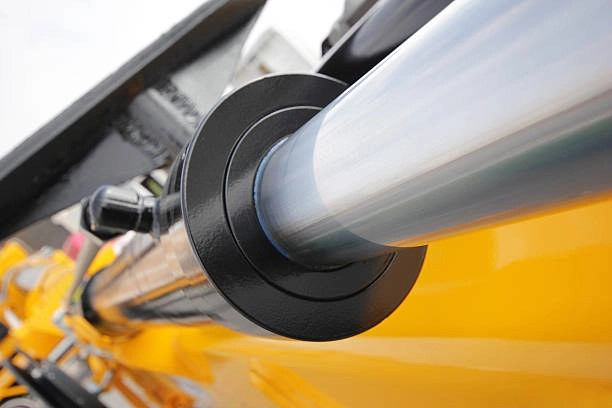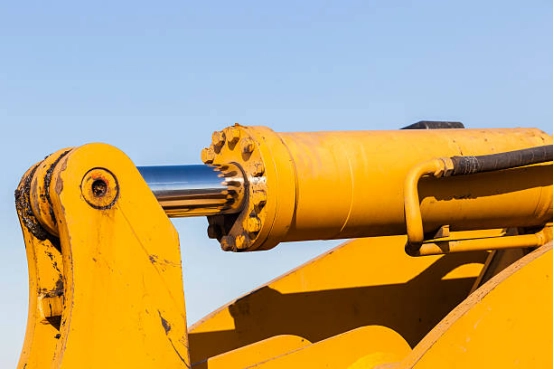
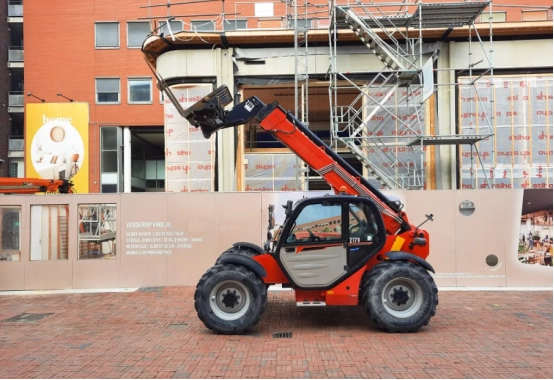
Telescopic forklifts put special pressure on the hydraulic system. A telescopic forklift hydraulic cylinder needs more than bore and stroke for proper selection. Load capacity counts. Its action near the end of the stroke also needs attention.
For equipment manufacturers these details often decide if a cylinder runs reliably for years. It may start creating service problems after a few hundred operating hours instead.
What Hydraulic Cylinders Are Used in a Telescopic Forklift?
A telehandler normally uses several hydraulic cylinders, each working under different mechanical conditions.
The boom lift cylinder carries much of the load involved in raising and lowering the boom. The telescopic cylinder controls horizontal extension. Steering cylinders work through shorter strokes but may cycle much more frequently. Tilt, leveling and attachment cylinders control the fork carriage, bucket, clamp or other working tools.
6 Key Hydraulic Cylinder Requirements for Telescopic Forklifts
Cylinder design needs to be considered as a system rather than a group of isolated dimensions.
1. Sufficient Load Capacity and Working Pressure
The cylinder must generate enough force for the worst realistic operating condition, not just the nominal load printed on the machine specification sheet.
Boom angle matters. So does load distance. A pallet positioned farther from the front axle creates a very different mechanical condition from the same pallet held close to the chassis.
Pressure spikes also deserve attention. A telehandler crossing uneven ground while carrying a load can create short hydraulic pressure peaks that do not appear during a static calculation. Similar spikes can occur when boom movement stops abruptly.
2. Proper Stroke and Compact Installation Dimensions
Telehandlers need long reach, but the hydraulic components still have to fit inside a limited boom structure.
Small dimensional errors are not always small in practice. A port positioned 20 mm too close to a boom plate may interfere with hose routing. A cylinder that is slightly longer when retracted can prevent the boom from closing completely.
OEM drawings should define stroke, closed length, extended length and mounting geometry together.
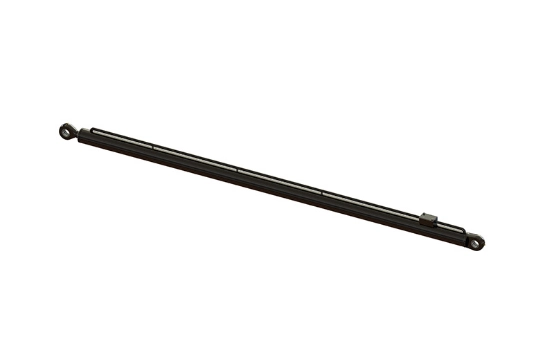
3. Piston Rod Strength and Buckling Resistance
Long-stroke cylinders deserve particular attention at the piston rod.
When a rod is working under compression, diameter alone does not tell the full story. Unsupported length, mounting arrangement and the alignment of the cylinder all affect buckling resistance.
Straightness and surface condition matter as well. Even slight bending can increase side loading on the guide and seals. The result may not be an immediate failure. More often, the first sign is uneven seal wear or a polished strip appearing on one side of the rod.
4. Reliable Sealing and Contamination Resistance
Telehandlers rarely work in clean environments.
Dust, concrete particles, sand, mud and dried grease collect around exposed hydraulic components. Every time the piston rod retracts, the wiper becomes the barrier between that contamination and the cylinder interior.
Seal selection therefore needs to reflect more than pressure. Hydraulic fluid type, oil temperature, rod speed and expected contamination should all be considered.
A leaking rod seal is easy to notice. Contamination entering through a weak wiper can be more expensive because the damage develops inside the cylinder. Scored tubes, damaged piston seals and contaminated hydraulic oil may appear much later.
For construction machinery, reliable sealing and a robust wiper arrangement are not optional details.
5. Corrosion and Wear Protection for Outdoor Operation
A telehandler may spend its entire service life outdoors.
Rain, washing water, fertilizer, road salt and coastal air can attack exposed rod surfaces. Chrome plating that performs well in a dry warehouse may not provide enough protection for equipment working around ports, farms or winter construction sites.
The piston rod surface must balance corrosion resistance with hardness and wear resistance. The correct treatment depends on the machine environment.
One useful rule is to discuss the real operating site before specifying the rod coating. “Outdoor use” is too broad. A rental telehandler working on ordinary building sites has different exposure from a machine handling material near seawater.
The extra discussion is usually cheaper than replacing corroded rods later.
6. Cushioning and Structural Durability
Heavy boom movement carries considerable kinetic energy.
If a cylinder reaches the end of its stroke without suitable deceleration, that energy is transferred into the piston, cylinder head, mounting pins and machine structure. Operators feel it as a hard stop. Components experience it as repeated impact loading.
A properly designed cushion slows piston movement near the stroke limit and reduces those loads.
The mounting ends deserve similar attention. Forged or adequately reinforced connection components are generally preferable where high cyclic loads are expected. Weld quality and heat treatment also become important on cylinders that work continuously under heavy equipment conditions.
A cylinder may meet the required static force and still have poor service life if fatigue loading is ignored.
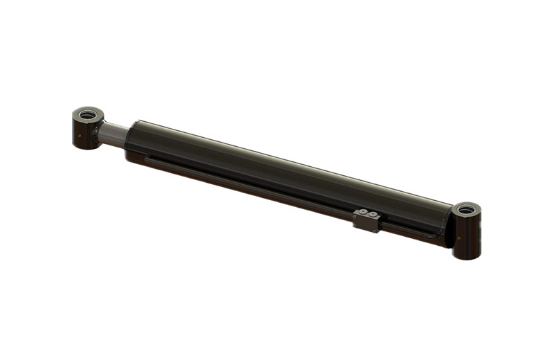
What Information Should OEMs Provide to a Hydraulic Cylinder Manufacturer?
Good cylinder development normally starts with more information than a bore and stroke request.
Useful inputs include the cylinder function, working pressure, maximum system pressure, required push and pull force, stroke, closed length, mounting dimensions, pin diameter, port specification, hydraulic fluid and operating temperature.
Duty cycle is worth mentioning. So is the environment.
For a replacement or redesign project, an existing drawing, failed sample or 3D model can save considerable time. Photos of the installation are useful too, especially when hose clearance or interference is difficult to understand from a two-dimensional drawing.
Why Custom Hydraulic Cylinders Are Often Better for Telescopic Forklifts
Standard cylinders work well when the machine has been designed around a standard component. Telescopic forklifts are often less convenient.
Boom dimensions are tight. Stroke requirements can be unusual. Port locations may be dictated by hose routing inside the boom. Mounting geometry may leave little freedom for adjustment.
In these cases, a custom hydraulic cylinder allows the bore, rod diameter, stroke, mounting ends, seals, cushioning and surface treatment to be developed around the machine.
That does not mean every telehandler needs an exotic cylinder. Quite the opposite. A good custom design is often mechanically simple. It simply puts the important dimensions and materials where the application actually needs them.
Shining Hydraulic develops hydraulic cylinders for construction and material handling equipment, including telescopic forklift applications. For OEM projects, cylinder specifications can be developed around equipment drawings, installation dimensions and real operating conditions rather than forcing the machine to accept an unsuitable standard cylinder.
Conclusion — Specify the Cylinder Around the Machine
Reliable telehandler cylinders come from understanding the machine around them.
Pressure and load calculations are essential, but field problems often appear elsewhere: insufficient rod stability, poor hose clearance, contamination around the gland, corrosion on an exposed rod or repeated impact at the end of stroke.
These details are easier to correct during design than after machines have entered service.
For new equipment or replacement-cylinder projects, Shining Hydraulic can develop telescopic forklift hydraulic cylinders according to operating pressure, stroke, mounting geometry, working environment and OEM drawings.
Contact Shining Hydraulic to discuss your telescopic forklift hydraulic cylinder requirements.
FAQs About Telescopic Forklift Hydraulic Cylinders
Q: What type of hydraulic cylinder is used in a telescopic forklift?
Telescopic forklifts normally use several types of cylinders, including boom lift cylinders, boom extension cylinders, steering cylinders, tilt or leveling cylinders and attachment cylinders.
Q: What determines the size of a telehandler hydraulic cylinder?
Cylinder size is mainly determined by required force, system pressure, stroke, available installation space and mounting geometry.
Q: When does a telescopic forklift need a custom hydraulic cylinder?
A custom cylinder is usually appropriate when the machine has restricted installation space, non-standard mounting dimensions, long stroke, high pressure, unusual port locations or demanding environmental conditions.