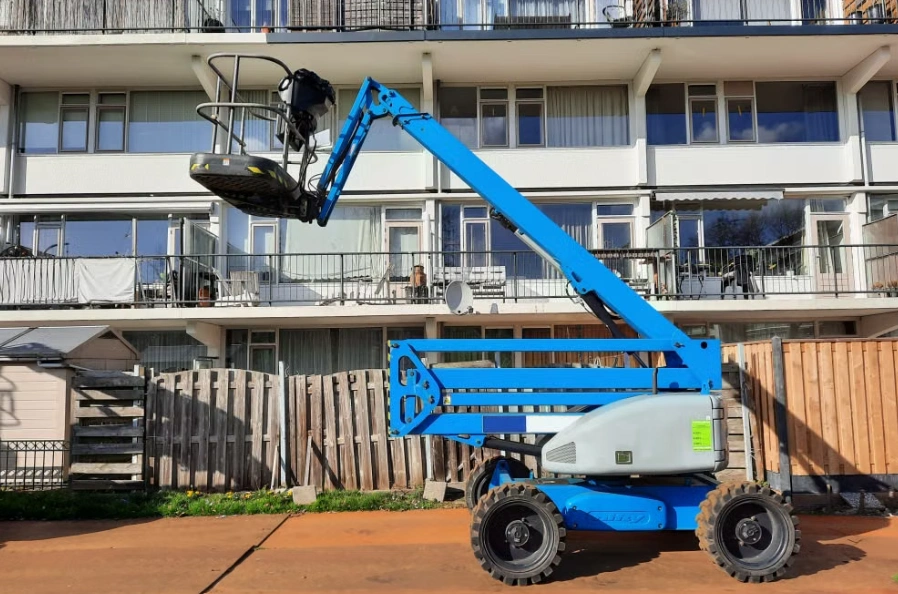
Articulating boom lifts seem straightforward from the ground. They consist of a chassis, several boom sections, a platform, and a hydraulic system. This system moves the whole structure. In actual use every movement relies on the hydraulic cylinders. These cylinders must handle their tasks under varying load conditions.
A cylinder that works well in a fixed machine may not act the same on an aerial work platform. Boom angles keep shifting. The applied force changes along with them. Side loads appear during operation. Outdoor exposure adds dust, moisture, and temperature variation.
For OEMs, selecting hydraulic cylinders for articulating boom lifts is less about choosing a standard bore and stroke and more about matching the cylinder to the machine geometry, duty cycle, and expected working environment.
How Hydraulic Cylinders Work in Articulating Boom Lifts
A typical articulating boom lift uses several cylinders rather than one main lifting cylinder. Each works under a different load pattern. Some carry high loads at low speed. Others move more frequently and require smoother response.
That difference matters during cylinder design.
Boom Lift Cylinders
Boom lift cylinders raise and lower the primary boom section. They usually carry some of the highest structural loads in the hydraulic system.
The difficult condition is not always maximum height. Depending on the boom geometry, cylinder force can peak at a relatively low boom angle where mechanical leverage is unfavorable.
This is why bore sizing should be based on actual force calculations rather than platform capacity alone.
Articulation Cylinders
Articulation cylinders control movement between connected boom sections.
These cylinders let the platform pass over obstacles. They help it move around structures. Operators can reach positions that a straight telescopic boom cannot access. Pin positions matter. Closed length, stroke, and mounting geometry affect the final movement range. A small change in dimensions can alter the boom angle more than expected.
Telescopic Cylinders
Some articulating boom designs combine articulation with telescopic extension.
In these machines, telescopic cylinders extend and retract the boom section. Long stroke creates additional concerns around rod stability, internal guidance, straightness, and installation alignment.
A cylinder may pass a pressure test and still perform poorly if the rod is too slender for the extended condition.
Leveling and Steering Cylinders
Leveling cylinders help maintain platform orientation as the boom moves. Steering cylinders control wheel direction on many mobile aerial work platforms.
The loads may be lower than those on the main boom cylinder, but movement quality matters. Excessive internal leakage, clearance, or uneven response becomes noticeable very quickly when precise positioning is required.
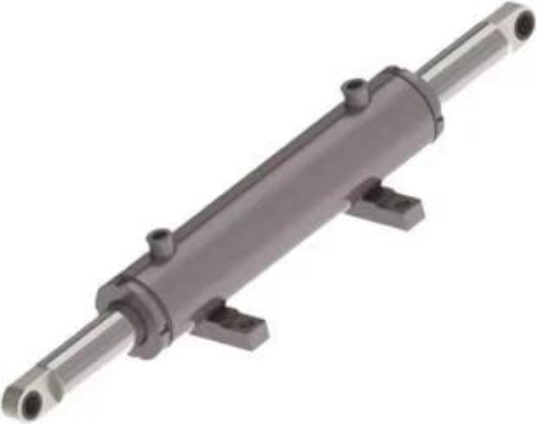
Key Requirements for Articulating Boom Lift Hydraulic Cylinders
For an articulating boom lift hydraulic cylinder, nominal pressure is only one part of the specification. Machine geometry often determines whether the cylinder will have a comfortable service life or spend most of its time working near its limit.
Load Capacity and Working Pressure
Cylinder bore and system pressure determine available hydraulic force, but the calculation should include boom weight, rated platform load, linkage geometry, friction, acceleration, and a reasonable design margin.
Consider a boom lifting a loaded platform from a low position. The cylinder may see its highest force during the early part of the lift, not when the platform reaches maximum working height.
That operating point deserves attention.
Stroke Length and Installation Space
Stroke must provide the required boom movement while keeping retracted length within the available installation envelope.
OEM projects often become difficult here. There may be enough room for the required stroke, but not enough room for the desired mounting arrangement, port position, end fittings, and hose clearance.
Cylinder design has to fit the machine, not the drawing in isolation.
Rod Strength and Buckling Resistance
Long rods under compression need careful checking.
Rod diameter, unsupported length, material properties, mounting type, and load alignment all influence buckling resistance. Increasing rod diameter can solve one problem but create another by changing retraction force or cylinder packaging.
There is usually a practical balance.
Smooth and Precise Movement
An aerial platform should move without sudden jumps. This holds true when the operator makes a small control input.
Seal friction plays a role in movement quality. Internal clearances affect it too. Hydraulic flow, cylinder alignment, and load variation also matter. Smooth extension is very important. Controlled retraction matters just as much. Operators often work close to walls, pipes, beams, or other structures.
Important Design Features OEMs Should Consider
Two cylinders with the same bore and stroke can behave very differently in service. Details around mounting, sealing, rod treatment, and ports often explain the difference.
Cylinder Mounting
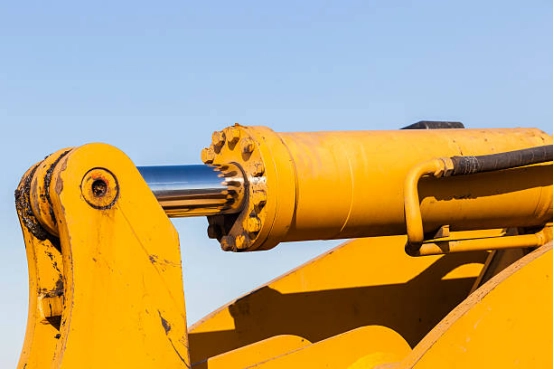
Clevis, pin, and trunnion arrangements are common choices.
Whatever the configuration, the cylinder should be allowed to follow the intended movement path without introducing unnecessary side load. Misaligned mounting pins are a recurring cause of rod, bearing, and seal wear.
Sealing System
Seal selection should reflect actual operating conditions.
An outdoor aerial work platform hydraulic cylinder may experience rain, construction dust, cold starts, long idle periods, and repeated pressure cycles. Rod seals, wipers, guide rings, and piston seals need to work together rather than being selected separately by habit.
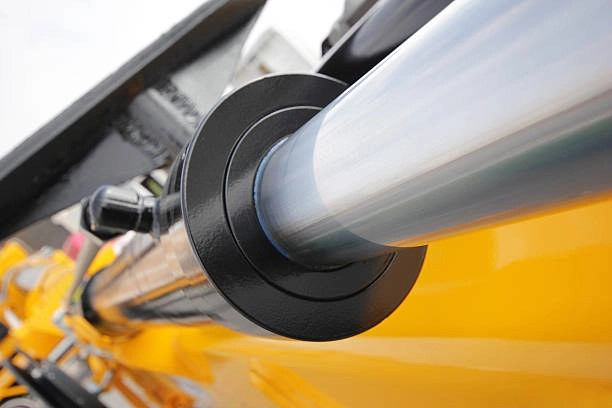
Piston Rod Surface Treatment
The piston rod is continuously exposed during operation.
Chrome quality, surface finish, hardness, and corrosion resistance have a direct effect on seal life. In coastal, humid, or chemically aggressive environments, standard surface protection may not be enough.
Rod corrosion usually starts small. Seal damage comes later.
Port Configuration
Port position looks minor until the cylinder is installed inside a narrow boom structure.
Poor port orientation can force tight hose bends, interfere with nearby components, or complicate assembly. For OEM production, correct port location can save more installation time than expected.
Common Hydraulic Cylinder Problems in Boom Lift Applications
Common field complaints include oil leakage, cylinder drift, bent rods, corrosion, damaged seals, and jerky motion.
Cylinder drift deserves close attention. External leakage is easy to spot. Internal leakage across the piston stays hidden. A platform that slowly shifts position under load may indicate seal wear. It can also point to valve leakage.
Bent rods often signal more than weak rod strength. Misalignment may be the real cause. Damaged pins, worn bushings, or unexpected side loading can contribute. Replacing the cylinder without checking the mechanism can bring the same failure back into service.
Standard vs Custom Hydraulic Cylinders for Articulating Boom Lifts
Standard cylinders prove useful when the machine has been designed around standard dimensions.
Boom lifts rarely offer that much freedom.
Mounting distance, stroke, bore, rod diameter, working pressure, port location, sensor requirements, and installation space usually tie closely to the equipment structure. This makes custom hydraulic cylinders for boom lifts the more practical choice for many OEM projects.
Customization does not need to add unnecessary complexity. In a good design it simply means the cylinder fits the machine. The machine does not have to adjust to fit the cylinder.
How to Choose a Hydraulic Cylinder Manufacturer for Boom Lifts
An OEM hydraulic cylinder manufacturer should be able to discuss more than price and delivery time.
Engineering support matters. Machining accuracy counts as well. Welding consistency is important. Tube quality, rod processing, seal selection, pressure testing, and dimensional inspection all play a part.
Useful information for a new project normally includes bore, rod diameter, stroke, working pressure, mounting dimensions, port type, installation orientation, operating environment, and estimated annual volume.
Drawings are even better.
A supplier that identifies a questionable mounting detail before production is usually more valuable than one that simply manufactures exactly what appears on the print.
Hydraulic Cylinder Solutions from Shining Hydraulic
Shining Hydraulic manufactures hydraulic cylinders for machinery applications, including aerial work platforms and other mobile equipment.
For articulating boom lift projects, cylinders can be developed around equipment-specific requirements such as bore size, rod diameter, stroke, mounting configuration, pressure rating, and port arrangement. Engineering and manufacturing decisions can then be coordinated with the actual installation rather than treated as separate steps.
For OEM sourcing or a new boom lift project, send Shining Hydraulic your cylinder drawing or application requirements to discuss a customized hydraulic cylinder solution.
Conclusion
A boom lift cylinder spends its working life dealing with changing geometry. That is what makes the application demanding.
Pressure rating matters, but so do rod stability, mounting alignment, seal behavior, corrosion protection, and small dimensional details that only become obvious once the cylinder is installed.
For OEM equipment, the better cylinder is usually the one designed around the machine rather than selected from a catalog because the bore and stroke happen to match.
FAQ
Q: What hydraulic cylinders are used in articulating boom lifts?
Articulating boom lifts commonly use boom lift cylinders, articulation cylinders, telescopic cylinders, leveling cylinders, and steering cylinders. The exact configuration depends on the machine design and working height.
Q: How do you size a boom lift hydraulic cylinder?
Sizing normally considers required force, system pressure, bore diameter, rod diameter, stroke, boom geometry, mounting position, and buckling resistance. Platform capacity alone is not enough for accurate cylinder sizing.
Q: Why do boom lift hydraulic cylinders drift?
Cylinder drift may come from internal piston seal leakage, control valve leakage, worn components, or contamination. The hydraulic circuit and cylinder should both be checked before replacing parts.